



Trying to format citations correctly during a late-night assignment can feel unnecessarily stressful. While working through research papers, understanding mla vs apa differences explained became a game changer because it simplified everything from citations to formatting. Instead of memorizing rules, it helps to see how each style fits its academic purpose and how small differences can impact your entire paper.
What Is MLA Vs APA?
Before comparing them, it helps to understand what each style is designed for and why it exists.
MLA Style Basics
MLA (Modern Language Association) is commonly used in humanities like literature, arts, and philosophy. It focuses on authorship and page numbers, helping readers locate ideas within texts easily. This style values who wrote the content more than when it was published.
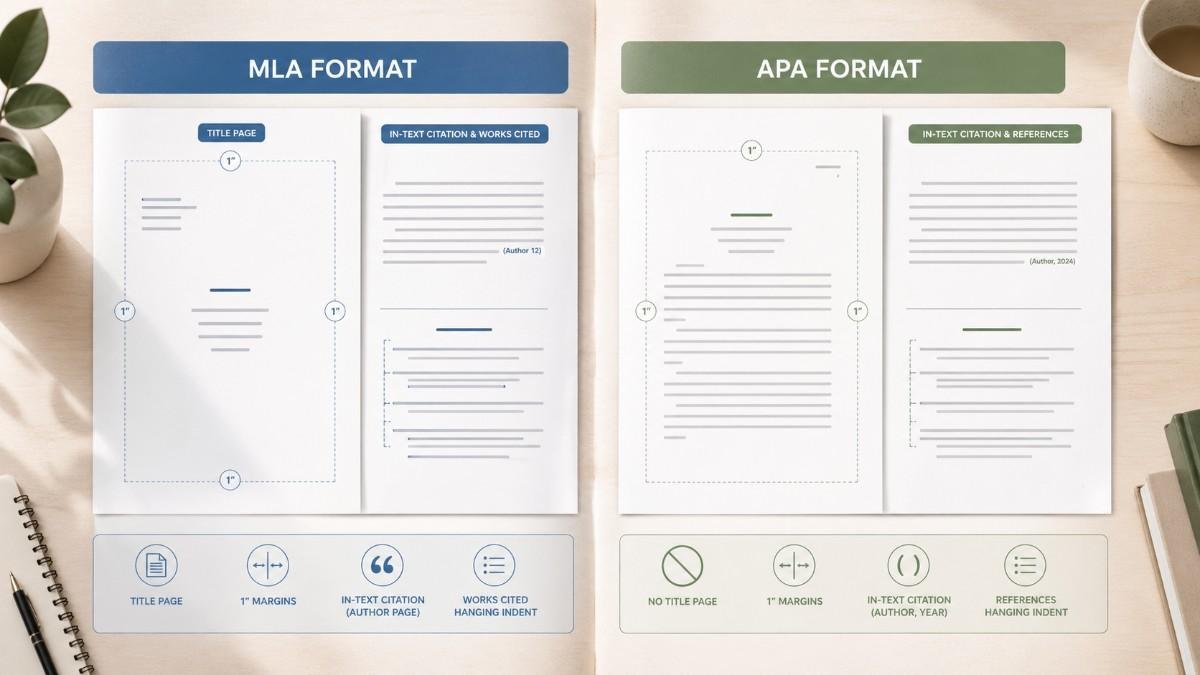
MLA formatting is simple and clean. It usually does not require a title page and uses a Works Cited page at the end. The structure is designed to keep attention on the content rather than formatting complexity.
APA Style Basics
APA (American Psychological Association) is used in social sciences such as psychology, education, and business. It emphasizes research timeliness, which is why publication dates are important. The focus is on how recent and relevant the information is.
APA requires a title page and a References section. It also includes specific formatting elements like headings, abstracts, and structured sections that reflect scientific writing standards.
Core Purpose Difference
The biggest difference comes down to intent. MLA highlights authors and their ideas, while APA highlights the timing of research. This difference influences everything from in-text citations to the structure of your paper.
MLA Vs APA Differences Explained In Simple Terms
Understanding the differences becomes much easier when broken into clear, practical comparisons.

In-Text Citations
MLA uses the author’s last name and page number, like (Smith 123). This helps readers quickly find the exact location of the information in the source.
APA uses the author’s last name and publication year, like (Smith, 2023). This highlights how current the information is, which is crucial in research-heavy subjects.
Both styles aim for clarity, but they prioritize different details depending on the field.
Source List Page
MLA calls its source list the Works Cited page. It includes full author names and follows a straightforward listing style.
APA uses a References page. It formats names using initials and places the publication year right after the author’s name, reinforcing the importance of timeliness.
Author Names And Formatting
MLA spells out full first names, such as Doe, John. APA shortens names to initials, like Doe, J. This difference may seem small, but it reflects APA’s preference for concise academic presentation.
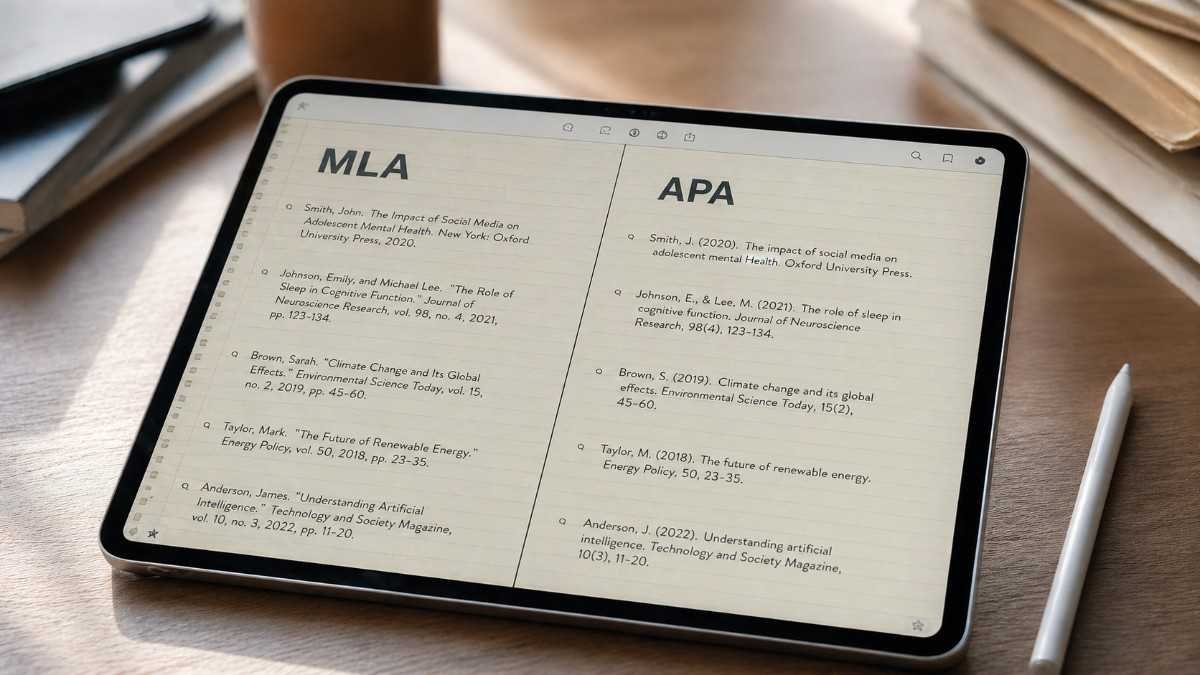
Real-World Citation Examples That Make It Click
Seeing actual examples helps you understand how these citation styles work in practice.
Book Citation Example
MLA format:
Smith, John. Climate Change Today. Penguin, 2020.
APA format:
Smith, J. (2020). Climate change today. Penguin.
The difference lies in name formatting, capitalization, and placement of the year.
Website Citation Example
MLA format:
Doe, Jane. “Global Warming Trends.” Science Daily, 2022.
APA format:
Doe, J. (2022). Global warming trends. Science Daily.
APA keeps titles in sentence case, while MLA uses title case.
Before And After Formatting
Before using MLA format:
“Climate change is accelerating rapidly” (Smith 45).
After switching to APA format:
“Climate change is accelerating rapidly” (Smith, 2020, p. 45).
This comparison clearly shows how APA adds context through the year.
Formatting Differences That Impact Your Grades
Even small formatting errors can affect your final score, so understanding these rules matters.
Title Page And Structure
MLA generally does not require a title page. Instead, it uses a header with your name, instructor, course, and date.
APA requires a formal title page that includes the paper title, author name, and institution. This gives the paper a more structured and professional appearance.
Date Usage And Placement
In MLA, the date appears later in the citation. In APA, the date is placed immediately after the author’s name. This emphasizes how recent the research is.
Capitalization Rules
MLA uses title case, meaning most major words are capitalized. APA uses sentence case, where only the first word and proper nouns are capitalized.
MLA Vs APA Differences Explained With Multiple Authors
Handling multiple authors is often where confusion begins.
| Scenario | MLA Format | APA Format | Key Difference |
| Two Authors | (Smith and Lee 45) | (Smith & Lee, 2020) | MLA uses “and”; APA uses “&” and includes the year |
| Three Authors | (Smith et al. 45) | (Smith et al., 2020) | Both use “et al.”, but APA includes the year |
Why This Matters
Correctly citing multiple authors improves clarity and avoids losing marks. It also ensures your work looks professional and credible.
How To Cite for MLA and APA Explained in Easy Steps
Applying the differences step by step makes the process much easier.
- Start by identifying your subject area because humanities subjects usually require MLA while social sciences use APA.
- Next, carefully read your assignment guidelines since professors often specify the required format.
- Then format your in-text citations correctly into your literature review or content analysis by deciding whether to include page numbers or publication years.
- After that, structure your Works Cited or References page using the correct naming and formatting rules.
- Lastly, review your paper for details like capitalization, title pages, and spacing to ensure consistency throughout.
Which Style Should YOU Use?
Choosing the correct style becomes simple when you follow a logical path.

Decision Flowchart
Start with your subject area. If your paper is related to literature, arts, or humanities, MLA is the right choice. If your topic falls under psychology, education, or business, APA is more appropriate. Always double-check your professor’s instructions because they override general rules.
Practical Tip
When unsure, look at your course syllabus or ask your instructor. Using the wrong style can affect your grades even if your content is strong.
Common Mistakes Students Should Avoid
Avoiding common citation errors can save time and improve your academic writing.
Mixing Styles
Using MLA and APA in the same paper creates inconsistency and confusion. Always stick to one format.
Missing Key Elements
Forgetting the publication year in APA or page numbers in MLA can weaken your citations.
Incorrect Formatting
Errors in capitalization, title pages, or reference lists are easy to make but also easy to fix with careful review.
Frequently Asked Questions
1. What are three differences between MLA and APA?
MLA uses author-page citations, APA uses author-year. While, MLA has Works Cited, APA has References. MLA often skips title pages, APA requires them.
2. How do I know if I should use MLA or APA?
Check your subject and assignment guidelines. Humanities use MLA, while social sciences use APA.
3. Why do people use APA over MLA?
APA highlights publication dates, making it ideal for research fields that rely on current data.
4. How to cite 3 authors in-text citations?
Use et al. MLA: (Smith et al. 45). APA: (Smith et al., 2020).
Now Master Citation in MLA Vs APA With Confidence
Understanding MLA vs APA differences explained helps you move beyond confusion and write with clarity and confidence. Once you recognize the purpose behind each style, applying the rules becomes much easier. Focus on consistency, follow your assignment guidelines, and use examples as your reference. With practice, switching between MLA and APA will feel natural and stress-free.